
Why Attendance Matters in Indiana Virtual School

Attendance Awareness Month comes around every September, and the question it raises outlasts the calendar: does attendance really "count" the same way when school happens at the kitchen table? In a virtual school, the answer is yes, and it often counts more. Attendance is one of the few signals a teacher can see from a distance, so it is the first place a problem shows and the first place a fix can start.
At Indiana eSchool Academy, a school day is recorded through engagement in ClassLink and the coursework behind it, which is why "logged in" and "attended" are not quite the same thing. If you are building your household rhythm now, our guide to structuring your student's day is a helpful place to start.
Below: what chronic absenteeism means, how an asynchronous school with optional live lessons counts a school day, the early warning signs, and the habits our most consistent families rely on.
What Counts as Chronic Absenteeism in Virtual School?
Chronic absenteeism means missing 10 percent or more of the school year for any reason, excused or unexcused (Attendance Works). On a typical 180-day calendar that is 18 days, or about two days a month. The threshold is the same for a virtual student; what changes is how a "missed day" gets recorded.
The line is not arbitrary. Research from the National Center for Children in Poverty found that chronic absence in kindergarten is linked to lower academic performance in first grade for children of every background (Chang and Romero, 2008), and a Johns Hopkins study found that students who miss school regularly are far less likely to graduate from high school (Balfanz and Byrnes, 2012).
Nationally, chronic absence nearly doubled during the pandemic, climbing from about 15 percent of students before 2020 to more than 28 percent in 2022. It has eased since, but according to the American Enterprise Institute, 22.6 percent of students were still chronically absent in the 2024–25 school year, more than one in five, and the pace of improvement is slowing.
Indiana makes this official. State law now defines chronic absenteeism as missing 10 percent or more of the school year for any reason, which works out to 18 days on a 180-day calendar (Indiana Public Media, 2025).
How Is Attendance Counted in Virtual School?
In a building, attendance is a body in a chair at the bell. In a virtual school, it is a record of engagement: logging in to the student portal, working through lessons, submitting assignments, joining live sessions where offered, and responding to teachers. Schools combine those signals into a daily or weekly attendance record, and most states set a minimum virtual students must meet, just as seated students do.
Three things follow:
A day with no login and no submitted work usually counts as an absence, even when the student meant to get to it later.
Asynchronous does not mean optional. The hours are flexible; the expectation that school happens every day is not.
Absences need to be reported. When a student is sick or the family has a planned absence, the Learning Coach reports it so the record stays accurate and the day can be excused where policy allows.
How Indiana eSchool Academy Tracks Attendance
Your student's recorded day comes from their activity in ClassLink LaunchPad and the courses inside it. For login help or a question about a recorded day, use the Indiana eSchool support portal.
What 18 Missed Days Means in Indiana: Chronic Absenteeism at Indiana eSchool Academy
In Indiana, missing 18 days on a 180-day calendar, for any reason, makes a student chronically absent, and state law expects schools to step in early, well before that point. Indiana's compulsory attendance law applies to virtual students exactly as it does to students in a building.
Indiana has moved quickly on attendance. Chronic absenteeism nearly doubled during the pandemic and was still 17.8 percent statewide in the 2023–24 school year, according to Indiana Department of Education data (Indiana Public Media, 2025). In response:
SEA 282 (2024) requires schools to adopt truancy prevention measures, actions designed to address attendance problems before a student becomes habitually truant (Indiana Department of Education, 2024).
SEA 482 (2025) set the formal 10 percent definition and requires schools to ask families to meet when a student reaches five unexcused absences within a 10-week period. The meeting is about finding ways to help, not about punishment, and excused absences don't trigger it (Indiana Senate Republicans, 2025).
For Indiana eSchool families, that means you should expect outreach from us well before 18 days, and we would much rather have that conversation at day five than day fifteen.
Attendance also connects directly to testing. The students who miss the most days are often the ones who miss ILEARN checkpoint windows in grades 3–8, and spring testing is where a strong fall attendance habit pays off.
One Indiana-specific tip: the state splits between Eastern and Central time. Our school day runs on the school's clock, so set your household start time to match it, not the county next door.
Why Does Attendance Carry Extra Weight for Online Students?
In a virtual classroom there is no hallway, no lunchroom, and no teacher noticing an empty desk, so attendance is often the first sign that something is off. That is not a weakness of online learning. It means families and teachers partner more closely.
Why it carries more weight online:
Momentum matters. Lessons build on one another, and a few quiet days can mean the next one makes no sense.
Habits transfer. The routine around logging in and showing up carries into study habits, focus, and follow-through.
The research holds online. Chronic absence is linked to lower performance and, over time, higher dropout risk, in every grade and setting.
None of this is meant to worry you. It is why our team watches attendance data and reaches out early when we notice a dip.
What Are the Early Warning Signs That Attendance Is Slipping?
The real signal is a shift from an occasional missed login to a consistent pattern, not any one bad week. Catching that pattern early is the best thing a family can do.
Common early signs:
Logging in later and later in the day
Skipping live sessions but completing asynchronous work, or the reverse
A drop in message or discussion-board participation
Assignments rushed in at the deadline after missed days
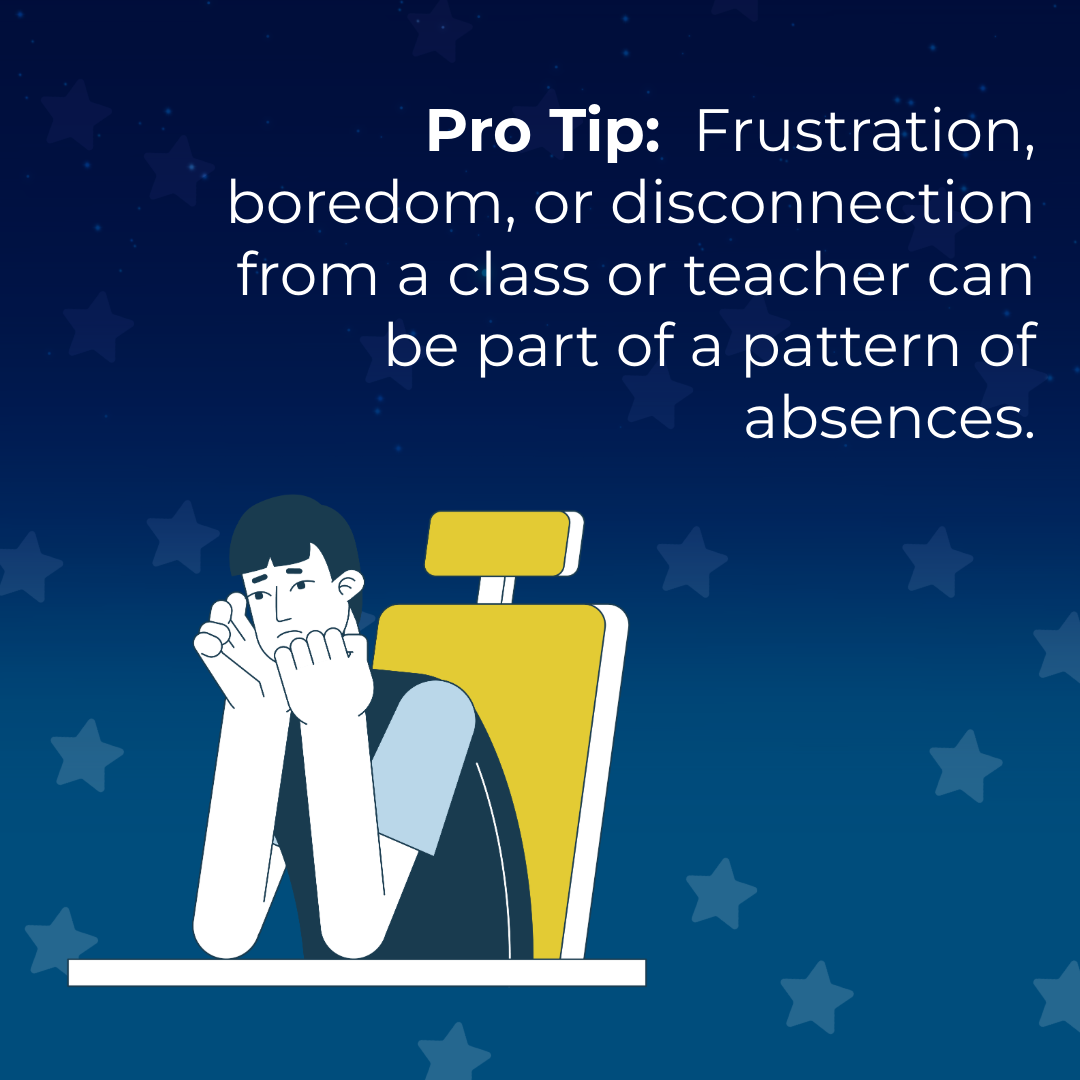
Frustration, boredom, or disconnection from a class or teacher (for the last one, see the ways virtual students build community)
If any of these sound familiar, it is not a sign of failure. It is a signal to check in with your student and their teacher.
How Do You Build Strong Attendance Habits in Virtual School?
The families with the strongest attendance treat login time like arrival time at a school building: same time, same place, same expectations, every day. Here is what tends to work.
Anchor a Consistent Start Time
Even with flexible scheduling, a predictable "school starts now" moment helps a student shift into learning mode. It does not have to be 8 a.m., just the same time most days. If your household needs that structure, a daily schedule built around your student's energy is the place to start.
Set Up a Dedicated Learning Space
A consistent physical spot, even a small one, cues the brain that it is time to focus. The kitchen table works, if it is the kitchen table every day.
Keep a Visible Weekly Calendar
Seeing the week laid out helps students, especially younger ones, understand what "showing up" looks like each day. Paper on the wall or a shared digital calendar both work, as long as the student can see it without opening a portal. Our time management strategies by grade level cover how to set one up.
Take Movement Breaks Instead of Skip Days
Restlessness is real, and the fix is a five-minute stretch break, a walk around the block, or a snack, not skipping the session. A skipped session becomes a skipped day faster than most families expect.
Tell Your Success Specialist Before a Rough Week, Not After
If life is about to get unpredictable, with illness, travel, a move, or a family event, a quick heads-up lets the team plan around it instead of reacting to a pattern later. If you are not sure who to message, our guide to who to contact for what at your virtual school lays it out.
What Should I Do If My Child Is Already Struggling With Attendance?
Reach out to your student's teacher or Success Specialist as soon as you notice a pattern; the earlier the conversation, the more options are on the table. Attendance dips rarely have one cause, and our staff can help you find out whether it is academic, social, or something at home.
A few things that often help:
A judgment-free check-in about what is making school hard to log in to
A temporary, modified schedule while the underlying issue gets addressed
Tutoring or academic support if the missed days have created gaps
Revisiting the daily routine and adjusting what is not working
If missed days have turned into missed work, our guide to how to catch up in virtual school without burning out is the next read.
Frequently Asked Questions

Does attendance affect my child's grades in virtual school?
Yes. Attendance is tracked alongside coursework completion, and consistent engagement is one of the strongest predictors of on-time progress and strong grades. In some states attendance also affects course credit or promotion directly, so know your state's rule.
How many days can a student miss in virtual school?
There is no single number, but most schools and states use 10 percent of the school year, about 18 days, as the line for chronic absence, and excused and unexcused days both count. Reporting an absence keeps a sick day from looking like a silent one.
What if my child is sick or we have a planned absence?
Excused absences are a normal part of school life; the goal is consistency, not perfection. Report the absence promptly through the process your school uses so the record stays accurate and the team can plan make-up work.
Is attendance tracked differently for asynchronous coursework?
Engagement is measured through logins, coursework activity, and participation rather than a single daily check-in, but the same 10 percent benchmark for chronic absence still applies.
How does Indiana define chronic absenteeism for online students?
Indiana defines chronic absenteeism as missing 10 percent or more of the school year for any reason, excused or unexcused, and the definition is the same for online and in-person students. On a 180-day calendar, that is 18 days. Separately, five unexcused absences within 10 weeks triggers a family meeting focused on support.
Can my student make up a missed day by working on the weekend?
The coursework usually can, and teachers are glad to see it. Whether it changes the attendance record depends on how your school defines a school day, so ask your Success Specialist before assuming.

Every Day Your Student Shows Up to Virtual School Is a Day They Move Forward
Consistent attendance is not about perfection. It is a rhythm your student can count on, week after week. Small, steady habits set up a confident year, and if a week goes sideways, our team is here to help you get back on track, not to judge the bumps.
At Indiana eSchool Academy, steady days in the fall become confident days in the spring. For building those habits from day one, see our guide to starting the school year strong.
Ready to help your student build a school year they can count on? Enroll today.
Follow us for more heritage-month resources and family activity ideas all year: Facebook | Instagram
Questions? Our enrollment specialists are ready to help: Call Now
Sources
American Enterprise Institute (Nat Malkus), From Attendance Crisis to Chronic Condition? Tracking Post-Pandemic Chronic Absenteeism into 2025 (June 2026). aei.org
Attendance Works, Calculate the Data (definition of chronic absence: 10 percent or more of school for any reason). attendanceworks.org
Hedy N. Chang and Mariajosé Romero, Present, Engaged, and Accounted For: The Critical Importance of Addressing Chronic Absence in the Early Grades, National Center for Children in Poverty, 2008. nccp.org
Robert Balfanz and Vaughan Byrnes, The Importance of Being in School: A Report on Absenteeism in the Nation's Public Schools, Johns Hopkins University Center for Social Organization of Schools, 2012. attendanceworks.org (PDF)
Indiana Department of Education, Indiana Attendance Guidelines Pursuant to Senate Enrolled Act (SEA) 282 (2024). in.gov/doe
Indiana Public Media (Kirsten Adair, IPB News), New law aims to further study chronic absenteeism in schools (May 2025). ipm.org
Indiana Senate Republicans, School Absence Reporting (SEA 482-2025). indianasenaterepublicans.com
